Willow. Tit Willow. Tit Willow.
It’s a bit of an inside joke that every time I think of dipping my toe into a difficult situation or feeling a difficult emotion, this Muppets song comes to mind. The willow tit is a European bird that looks like an American chickadee. The bird that originally illustrated the “dip my toe in” idea was the tufted titmouse. Close, I guess. Anyway, because of the inside joke, I have a willow tit/chickadee tattoo on my arm to remind me to be like the tufted titmouse. The tufted titmouse will fly to a bird feeder, pick up a single seed, and fly to a safe place to crack open the shell. In and out. In and out. In and out.
I recently started back to the gym again after another gut-issue hiatus. I am trying to take it somewhat slow so I don’t have to start over again. The heaviest barbell I have lifted has been 95 pounds (3 occasions), and the heaviest dumbbell has been 20 pounds (one occasion). For now, I am sticking with conditioning workouts that hover around twenty to thirty minutes. Those leave me enough time for an adequate warm-up and cool down before showering and returning home to simultaneously walk my dog and accompany my son on his walk to school. I digress.
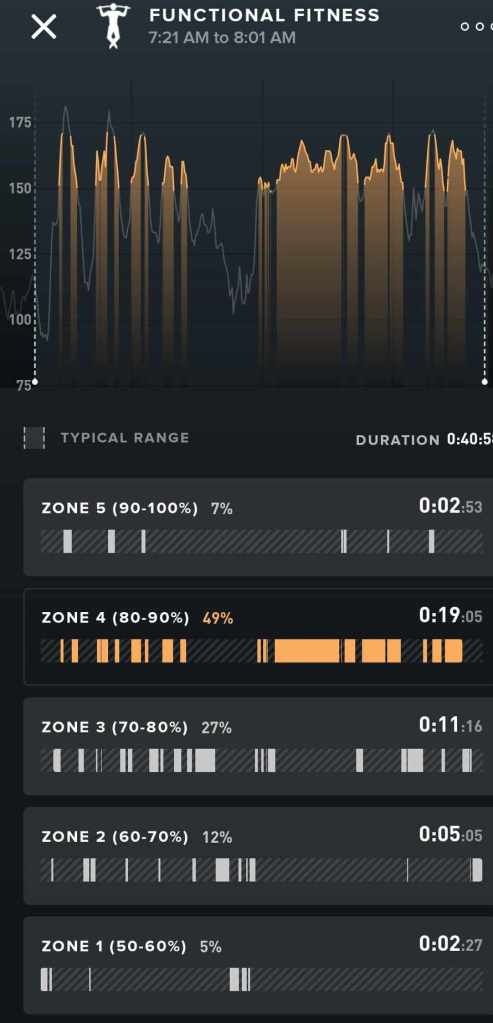
In my twenty- to thirty-minute workouts, I have noticed something interesting. Being a data person, I started plotting information about my heart rate and the sensations I have while in specific ranges—or at different thresholds. Here is what I have noticed. My heart rate can get up to about 200 beats per minute. In the past four weeks, it has maxed at 190 beats per minute. My average maximum heart rate has been 180 beats per minute. My average heart rate while working out has been about 141 beats per minute. My zone 5 heart rate is between 190 and 162 beats per minute. I can work out comfortably in that zone EXCEPT when I am 172 to 176 beats per minute. My zone 4 heart rate is between 146 and 162 beats per minute. I can work out comfortably in that zone EXCEPT when I am in the 154 to 155 beats per minute range. My heart rate seems to climb steadily until it hits 154. At that point, it is UNCOMFORTABLE. As soon as I hit 156 beats per minute, my body is suddenly relaxed again. I feel as though I breathe better, my muscles seem to be getting the right amount of oxygen/fuel again, and my heart doesn’t feel like it is pounding hard anymore. The same thing happens at the higher level. As soon as I transition from 171 to 172, I am uncomfortable and want to quit what I am doing. But, when my heart rate moves from 176 to 177, I drop back into a more comfortable feeling. No longer am I battling between quitting and pushing on.
When driving an automatic or standard transmission (excluding a continuously variable transmission) vehicle, you can watch the RPMs climb until the car changes gears. Once the car shifts into the correct higher gear, the RPMs drop. The car shifts when it needs to, or you shift the car when the RPMs dictate it is time. Of course, there are exceptions, but not shifting when the RPMs climb to a certain number can be a sign of a vehicle in need of repair or a driver who doesn’t know how to drive. But what if you are driving a manual and don’t understand how it all works? When the RMPs rise, maybe you panic and slow down to bring them down. Maybe you stall because you didn’t quite time things right.
What do birds, my heart rate, and cars have in common? Healing.
The tufted titmouse (willow tit…chickadee) takes a seed and leaves. It flies into the open where safety is not guaranteed, drops in to get what it needs, and flies back to safety to break the shell and eat the seed inside. By analogy, the tufted titmouse dips a toe in and quickly flies away to process and/or feel safe.
In contrast, my heart rate and the shifting car show what happens when we persist. I could stop what I am doing at 154 beats per minute when I feel uncomfortable–until it drops to a comfortable rate again. The problem is I am going to start my activity again and get stuck at that same threshold over and over again. I will never be able to push past the discomfort. The same goes for the car analogy. I can see the RPMs rise and make a decision. Should I pull over? Why are the RPMs so high? Should I shift? Should I take my foot off the accelerator and slow or impede traffic because I don’t want to or am afraid to shift? It seems logical that one would shift, but what if they are afraid they will miss the gear and stall? That’s uncomfortable. (I remember sitting at a stop sign in my hometown several years ago, unable to move because I kept stalling out. It was awful).
I often find it difficult to swoop in for some food because it feels unsafe. I feel like I should stop and rest when I feel uncomfortable. I want to drive a continuously variable automatic transmission so I don’t have to acknowledge the RMPs or feel the slight shift. But the fact of the matter is, I’ll starve if I don’t go to the birdfeeder. I’ll never run faster or lift heavier if I stop every time my heart beats harder. I’ll never get where I want to go if I refuse to shift my car.
I know the challenge. And it feels impossible. Yet, part of the reason I watch my heart rate at the gym now is to get comfortable with being uncomfortable. I want to use that sensation and discomfort to push myself when the mental and emotional discomfort tells me to stop and relax. Wanting and doing are two different things, but the practice at the gym is a good place to start.
 Burn the Boat!