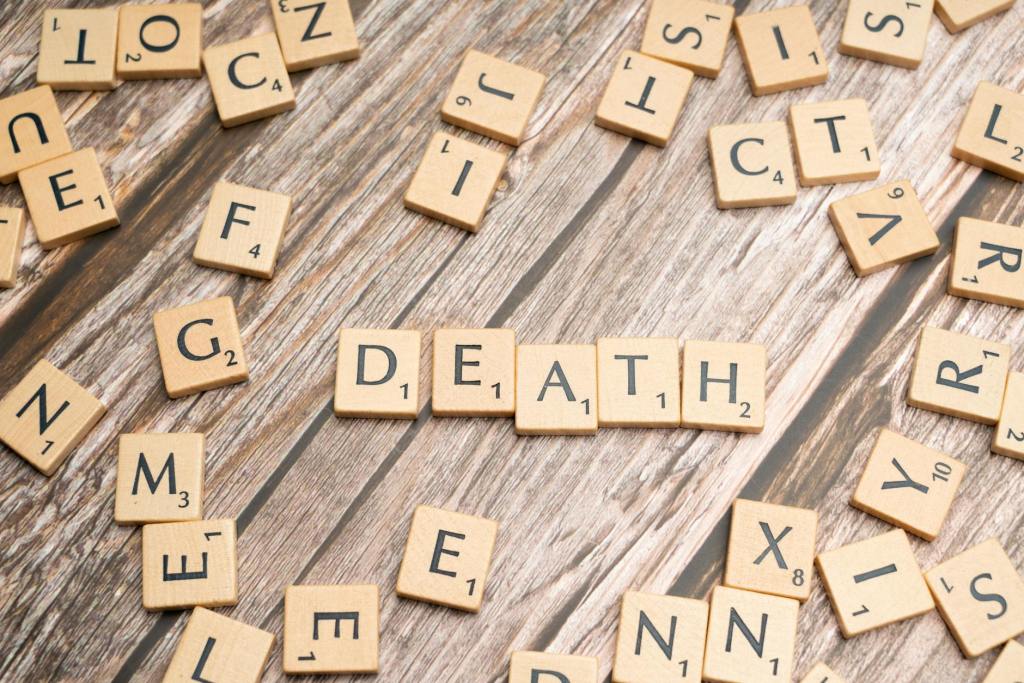
I started the New Year by reading about and focusing on death. It’s not because I am dying, preparing for someone else to die, or trying to deal with a past death, though I suppose all of those things are technically also true. Everyone close to me knows I have had my fair share of attempts to end my own life. But my focus on death has nothing to do with that either. So, why obsess about death? Aside from the obvious, we all face death; I will be mourning the death of myself. Not in a physical sense, but in a metaphysical sense.
Dr. C. has pointed out several times in our past 7.5 years that I seem to be hanging onto something. It’s as if I can’t shake the past, especially as it pertains to my identity with trauma. My life is largely entwined with trauma and the chaos that both predated and followed it. Since it started early, it’s hard to know who I was or who I would have been. I have to…I get to…decide who I am now, though. I get to do the redefining now. The problem with that is that the rest of me, in essence, has to die. The “victim” has to die.
First, I read The Gentle Art of Swedish Death Cleaning. It was a soft start. It was exactly as the title says, about cleaning. There are probably some physical things I could clean up or remove from my life, but I think, more than anything, I need to clean up my thoughts and the negative voices of those who don’t count in my head. From “ungrateful b*itch to “don’t tell anyone” and everything in between. It’s time to throw some things out.
Next, I read The Beauty of What Remains by Steve Leder. In that book, Steve Leder speaks about his father. He could be really rough around the edges, probably worked way too hard, pushed his son a bit more than he should have, and endured a loveless marriage. Yet, Leder was able to see beyond all the flaws, mistakes, and other negative characteristics, and recognize how beautiful his dad’s life and love really were. What remains IS love. The beauty of what remains lies in the motive behind every action, the positive changes made even on the last day of life, the effort, and the struggle. What remains of me will not be a broken or damaged 43-year-old. No, what will remain will be a woman who always tries her best, loves being outside and/or active, tries to love everyone though sometimes wth a little deprecating humor, and doesn’t give up even when she wants to (and threatens to).
I also read A Beginner’s Guide to the End by BJ Miller (a hospice doctor) and Shoshana Berger (a caregiver to her father). Mostly, it was about how to get your affairs in order, different types of healthcare, finances, legal matters, and more. But the book was also about being emotionally prepared and handling grief. Death can be crippling, and it can destroy people and relationships. It doesn’t have to. It can be an opportunity to perhaps see the beauty of what remains. Either way, this book reminded me that I can’t just happily send the victim on the long black train. Nope. I have to prepare. I need to have my affairs in order. I will need to grieve. This won’t be an easy death, no matter how badly I would like to say goodbye to the weary, unwanted traveler. Because here is the thing. This weary, unwanted traveler has also been a companion. Like Shrek and Donkey. Shrek wanted nothing more than for Donkey to go away, but they became best friends.
So, my next collection of books really has nothing to do with my preparation, but they fit the theme. I have had the Dexter book series on my wish list for quite some time. I received them for Christmas, so I am also working my way through those. Purely entertainment away from the usually dense books I tend to wade through, though I understand books about serial killers may not be everyone’s cup of tea. But even serial killers have a plan, so maybe I also need one. How exactly am I supposed to remove the victim from my life? Obviously not the way Dexter removes people, but how?
Finally, I am also reading Living with Borrowed Dust. It isn’t about death per se, but the Jungian psychoanalyst, James Hollis, has, with his words, challenged me to explore growth, challenges, and my own personal meaning apart from victimhood. As the title implies, we will return to the dust that we are made of, but the key is LIVING.
Let me be clear. This isn’t just a deep dive into death without actually facing actual death. I plan to do my best to help put the victim to rest as comfortably, humanely, and lovingly as possible. I plan to, along the way, see the beauty of what will remain after the victim is gone. Rather than letting her go, I have kept her alive, believing that is how I stay alive. Keep the bad so you don’t lose the good, too. But it doesn’t have to work that way. As any caretaker experiences, I am tired, burned out, held back, and missing out on so much around me while trying to keep this part of me alive.
I fully believe I will screw this up multiple times. I know I often take a stand on things not meant to be stood against. Or I rail hard in the opposite direction from what makes sense. Two examples:
When I was in Utah, each person in my group was encouraged to use their voice. We were each supposed to scream as loud and long as we could. I didn’t want to scream. It made me feel uncomfortable. I refused staunchly until I was challenged and called out. It wasn’t something to take a stand on. It was an opportunity to use my voice and be heard by everyone.
The last time I was hospitalized at PIW was right before I started with Dr. C. I was set to start with her and was feeling some confidence, strength, and courage in leaving the hospital, though still feeling very much not ready to leave yet. My doctor informed me that my insurance had cut me off, and I would be discharged the following day. The very place my brain felt safe and wanted to stay was the very place I almost successfully broke out of. As I was inching out the magnetically locked door, I was told I could either calm down or get the triple threat cocktail shot in my butt that would knock me out for hours. I chose to calm down. Regardless, it made no sense to attempt to escape a place I was fighting to stay in.
What I do know is that in both examples, I was just trying to feel safe and in control of the situation while avoiding discomfort. The problem was that I would never be in control as long as I let situations and other people affect me as they do. The victim will continue to believe that no one and nothing is safe. The victim will always see situations as proof that the world is out to get me. The victim will always hold me back by not allowing me to use my voice and by holding me in a place that isn’t reality. I have to be uncomfortable. I won’t always be in control. I have to grieve what has happened and then let it go, without seeing every fresh offense as a new reason to distrust myself and the world. I have to work to know and like the person I am and can become without the victim. I get to mold her afresh.
During my last session with Dr. C., I asked her a question just before the end of my hour. “What is the opposite of victim?” The word that stuck with me was “agency.” Agency is having power to act. It’s being in charge of my present and future.
I don’t yet know what any of that looks like, but my intention for 2026 is metaphysical death through daily choices to live. I am learning how to die so I can finally live. Here are a few things I have started so far: I applied to college. Yes, I have a master’s, but I have been thinking about what I want to do with the rest of my life, and I am pretty sure it isn’t working where I am right now. I am developing a strategy to step down from a board position at a local youth soccer program, but that means I am also working to set it up for success now. After years of saying I needed to get a new Primary Care Physician, I finally set up an appointment with one. Some of these seem big and some small, but they are all things I have thought about but never acted on. The only way to eradicate the victim is to empower the SELF who needs and wants to live.
 Burn the Boat!